CLDN18.2-positive gastric cancer: what does the result mean?
A positive CLDN18.2 result opens discussion about targeted therapy and clinical trials, but it does not automatically mean one treatment is available or suitable for every patient.
Prepared and published by TanyaKanker
For: People with gastric cancer and families who have received a CLDN18.2 test result
Ask about advanced therapy
Understand which documents and markers should be discussed with a doctor.
After submission, a human navigator reviews your request and contacts you through your chosen channel. The WhatsApp message already includes this page context, so you do not need to explain from the beginning.
Clinical data is not requested in the form and is not sent to analytics. Do not send medical reports through WhatsApp or email; use the secure upload page. We do not promise eligibility or any treatment outcome.
Medical review status
30-second answer
The key point
A positive CLDN18.2 result opens discussion about targeted therapy and clinical trials, but it does not automatically mean one treatment is available or suitable for every patient.
This is an educational summary, not a diagnosis or final treatment recommendation.
What CLDN18.2 is
A positive CLDN18.2 result means tumor cells show this protein at a level that meets the test threshold. The meaning depends on stage, general condition, prior treatment, other markers such as HER2 and PD-L1, and local availability.
CLDN18.2 is normally found in the stomach lining. In some gastric and gastroesophageal-junction cancers, it remains present on tumor cell surfaces.
Because it is more visible on tumor cells than on many other normal tissues, it has become a target for therapies designed to recognize it.
How it is tested
CLDN18.2 testing usually uses tumor tissue from biopsy or surgery, assessed by immunohistochemistry in a pathology laboratory.
Availability differs by hospital and country. If the pathology report does not mention CLDN18.2, ask whether stored tissue can be tested.
- Material: tumor tissue from biopsy or resection, usually a stored paraffin block.
- Method: immunohistochemistry with a positivity threshold set by pathology standards.
- Timing: most relevant in advanced or metastatic disease when systemic therapy is being discussed.
What a positive result means
A positive result supports discussion of therapies targeting CLDN18.2, but it is not proof that a specific treatment is available, approved, or right for the case.
The decision still depends on stage, condition, prior treatment, other markers, and care-setting availability.
Penjelasan visual
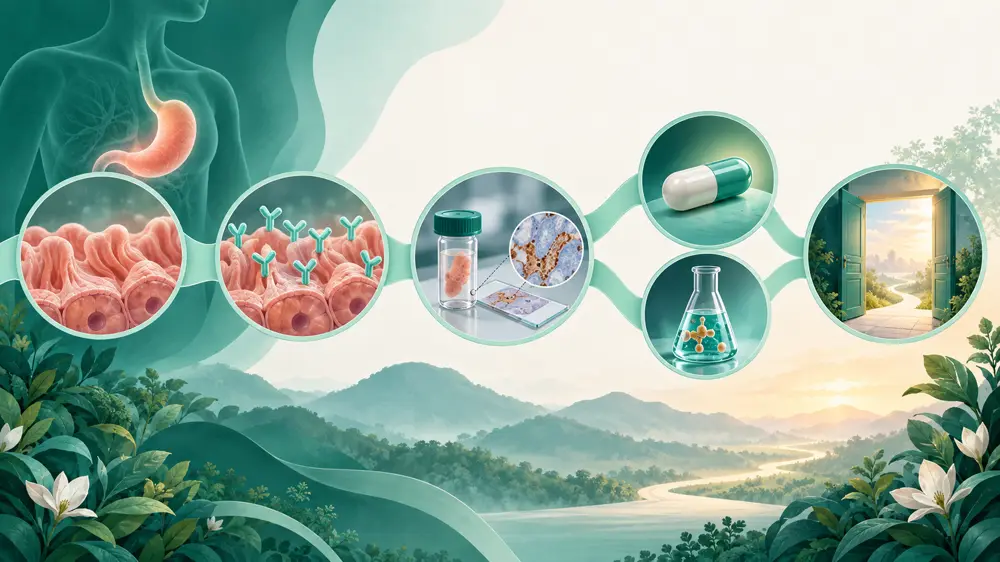
The CLDN18.2 journey in stomach cancer
From tissue testing to the questions worth asking after the result is available.
This diagram explains the sequence of assessment and discussion. It is not treatment advice or an eligibility decision.
Stomach cancer cells are examined
Assessment is performed on tumour tissue, not blood.
CLDN18.2 testing
The result is usually reported with a staining percentage and intensity.
Positive or negative result
Assessment thresholds may differ between facilities.
Options are discussed
Including options approved in a country and those still under investigation.
Clinical trial or second opinion
The next step depends on the records and the patient's condition.
A marker name in a report is the start of a discussion, not a decision.
Approved options and approaches still under study
Anti-CLDN18.2 monoclonal antibody treatment, such as zolbetuximab with chemotherapy, has been approved in several countries for defined HER2-negative CLDN18.2-positive gastric or GEJ cancer. In China, NMPA approved VYLOY in 2025 for a first-line indication under specified criteria. Approval and availability still differ by country and facility.
Other approaches, including CLDN18.2 CAR-T cells, antibody-drug conjugates, and bispecific antibodies, remain investigational and are not standard care.
- Approved in some countries: zolbetuximab plus chemotherapy for defined criteria.
- Still under study: anti-CLDN18.2 CAR-T, antibody-drug conjugates, and bispecific antibodies.
- Always check the current status in the country and facility where care is being considered.
Clinical trials and international access
Many CLDN18.2 trials run in China and other countries. A recruiting registry status does not mean international patients are accepted.
Use a trial finder to filter by condition and marker, then prepare pathology, CLDN18.2 IHC, HER2 and PD-L1 if available, recent imaging, and prior-treatment history.
Cost and access context
Cost components include marker testing, companion chemotherapy, inpatient care if needed, side-effect management, and repeated monitoring.
Availability and coverage differ across countries and facilities, including Indonesia. Confirm directly before assuming access or coverage.
In trials, the study drug may be provided by the protocol, but travel, accommodation, and international-patient administration are usually separate.
- Ask whether CLDN18.2 can be tested on stored tissue so repeat biopsy is not automatically needed.
- Request a written estimate covering medicines, testing, inpatient care, and excluded components.
- If local options are limited, consider whether a second opinion from another oncology center is useful before deciding on travel.
Questions worth asking the doctor
Good questions separate what is confirmed from what still needs checking.
- Has my tumor been tested for CLDN18.2, HER2, PD-L1, and MSI/MMR?
- What does my CLDN18.2 score mean under the laboratory threshold used?
- Is an anti-CLDN18.2 therapy available or accessible in my care setting?
- Which trials are relevant, and who can confirm international access?
- Would a second opinion from another oncology center be useful for my case?
Frequently asked questions
Short answers to common patient and family questions.
What does CLDN18.2-positive mean?
The tumor expresses CLDN18.2 at a test-defined level, which supports discussion of targeted options but does not guarantee access or suitability.
Does a positive result mean a medicine can be given immediately?
No. Stage, condition, prior treatment, other markers, and availability still matter.
Is zolbetuximab available for gastric cancer?
It is approved in several countries for defined criteria, including a 2025 Chinese approval for a first-line indication, but status must be confirmed locally.
If my pathology report does not list CLDN18.2, what can I ask?
Ask whether stored tissue can be tested by immunohistochemistry.
Which CLDN18.2 approaches remain investigational?
CAR-T cells, antibody-drug conjugates, and bispecific antibodies remain in clinical study.
What documents help trial exploration?
Pathology, CLDN18.2 IHC, HER2 and PD-L1 if available, recent imaging, and prior-treatment summary.
How this service works: uploads, privacy, and limits
TanyaKanker is a preparation tool, not a medical provider. It does not diagnose, choose treatment, promise treatment results, or decide trial suitability. It helps organize records and questions so discussion with the medical team is more focused.
- After upload: the site tools organize the answers and supplied documents into a structured case summary for consultation, second opinion, or trial exploration. It is not a diagnosis and not a treatment decision.
- Documents usually needed: pathology, immunohistochemistry results including CLDN18.2 plus HER2 and PD-L1 if available, recent imaging, and prior-treatment summary.
- Current privacy state: draft answers are kept on the user's device as structured data, without free text and without file names. Until sign-in and consent are completed, medical files are not sent to TanyaKanker servers. After sign-in and consent, files are stored in private storage with time-limited links and are never sent to analytics.
- Human review path: this guide has not been reviewed by a doctor, as stated in its review label. Requests sent through the consultation page are read and followed up by a human, not by an automatic reply. No medical outcome or response-time guarantee is made.
- Limits: treatment decisions remain with the patient and the medical team that examines the patient directly. Therapy availability and trial acceptance must always be confirmed with the relevant facility or study team.

Langkah berikutnya
If you have medical reports, build a case summary so your documents and questions are organised before consultation.