Tagrisso stopped working? Steps after osimertinib progression
When Tagrisso (osimertinib) stops controlling disease, the next step depends on the resistance mechanism found through retesting, not guesswork.
Prepared and published by TanyaKanker
For: Patients with EGFR-mutated lung cancer whose targeted therapy is starting to stop working
Tagrisso stopped working? Start with a human navigator
Leave your contact details or open WhatsApp first. Medical reports are submitted separately through the secure upload page.
After submission, a human navigator reviews your request and contacts you through your chosen channel. The WhatsApp message already includes this page context, so you do not need to explain from the beginning.
Clinical data is not requested in the form and is not sent to analytics. Do not send medical reports through WhatsApp or email; use the secure upload page. We do not promise eligibility or any treatment outcome.

Medical review status
30-second answer
The key point
When Tagrisso (osimertinib) stops controlling disease, the next step depends on the resistance mechanism found through retesting, not guesswork.
This is an educational summary, not a diagnosis or final treatment recommendation.
What osimertinib resistance means
Resistance means the cancer grows again even though osimertinib is still being taken. It does not by itself identify the cause.
Progression can appear in one site, several sites, or the brain, and that pattern affects what is discussed.
The medical team usually looks for the mechanism before choosing the next route.
Mechanisms often considered
Several mechanisms may be discussed after progression, and each one can point to a different category of next step.
- A second EGFR change such as C797S.
- MET amplification or another bypass pathway.
- Transformation into a different cell type, such as small-cell transformation.
- Progression limited to one or a few sites while other disease remains controlled.
What is usually retested
Doctors may consider repeat tissue biopsy, liquid biopsy, or both. The choice depends on safety, accessibility of a lesion, and the question being asked.
Tissue biopsy can show histology and transformation. Liquid biopsy can be easier to repeat and may capture DNA from several sites.
A negative liquid biopsy may happen when little tumor DNA is released into blood, so it does not always end the investigation.
Recent imaging helps decide whether progression is local, widespread, or in a sensitive site such as the brain.

Penjelasan visual
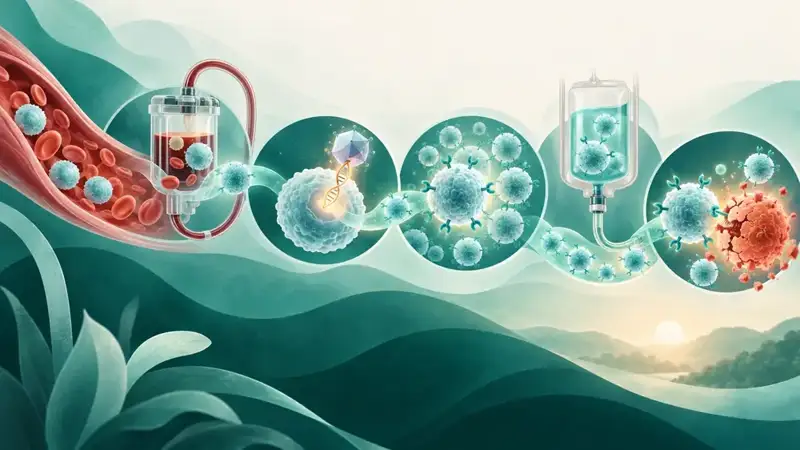
The EGFR journey after targeted therapy stops working
The sequence usually discussed when EGFR-targeted therapy no longer controls the disease. It covers tests and questions, not drug recommendations.
This diagram explains the sequence of assessment and discussion. It is not treatment advice or an eligibility decision.
An EGFR alteration is found
Recorded in the molecular report, not only in its conclusion.
Targeted therapy is given
Including the start date, dose, and reason for changing treatment when relevant.
The disease progresses
Assessed from imaging and the clinical condition by the treating doctor.
Possible resistance mechanisms
For example C797S, MET, or another alteration that may be found on repeat testing.
Repeat testing or NGS
Determines which changes are actually present in this case.
Discuss the next step
Reviewed with the doctor according to the patient's condition and available options.
When targeted therapy stops working, it does not automatically mean there are no further options to discuss.
Why the mechanism guides the option
A next-generation targeted option, chemotherapy, local therapy, immunotherapy combinations, or a trial may be discussed depending on the mechanism and the patient's condition.
No mechanism automatically guarantees access to a drug or a trial.
The treating doctor weighs previous treatment, organ function, performance status, and availability.
Clinical trials after progression
Trials after osimertinib often focus on a specific resistance mechanism or a defined treatment history.
A registry status of recruiting is only the starting point. The study team decides whether records meet protocol criteria.
International access, cost, and site readiness must be confirmed separately.
- Check whether the trial names the required EGFR or resistance marker.
- Ask what prior therapy lines are required or excluded.
- Confirm whether the site can review international patient records.
Cost and access context
Costs depend on testing, medicines, visits, travel, and whether the route is standard care or a trial.
Trial medicines may be supplied by the protocol, but travel, accommodation, and non-protocol care may still be the patient's responsibility.
Ask for written cost components before making travel or treatment decisions.
What to bring to the discussion
Complete, dated documents help the doctor read the sequence rather than a single result.
- Original EGFR report and method.
- Osimertinib start date, dose changes, and best response.
- Most recent CT, PET-CT, or MRI reports.
- Any repeat tissue or liquid biopsy results.
- Prior treatment list and reasons for stopping.
- Current symptoms and performance status.
- Current medicines and relevant comorbidities.
Frequently asked questions
Short answers to common questions are listed here; the sections above give the full context.
Does progression mean osimertinib was useless?
No. It means the disease is growing now despite the drug, and the next question is why.
Is a liquid biopsy enough?
Sometimes it helps, but a negative result may not be enough when the clinical question remains open.
Does C797S guarantee a fourth-generation EGFR medicine?
No. Access and use depend on approval status, trial protocol, and physician assessment.
Can local therapy be discussed?
Sometimes, especially when progression is limited, but the medical team must assess the whole case.
Should osimertinib be stopped immediately?
Do not stop or change treatment without the treating doctor's instruction.
What documents matter most for trial exploration?
Molecular results, imaging, pathology, and a clear prior-treatment timeline.
How this service works: uploads, privacy, and limits
TanyaKanker is a preparation tool, not a medical provider. It does not diagnose, choose treatment, promise treatment results, or decide trial suitability. It helps organize records and questions so discussion with the medical team is more focused.
- After upload: the site tools organize the answers and supplied documents into a structured case summary for consultation, second opinion, or trial exploration. It is not a diagnosis and not a treatment decision.
- Documents usually needed: pathology, original EGFR report, repeat tissue or liquid biopsy if available, recent imaging, treatment timeline, current medicines, and notes on symptoms or performance status.
- Current privacy state: draft answers are kept on the user's device as structured data, without free text and without file names. Until sign-in and consent are completed, medical files are not sent to TanyaKanker servers. After sign-in and consent, files are stored in private storage with time-limited links and are never sent to analytics.
- Human review path: this guide has not been reviewed by a doctor, as stated in its review label. Requests sent through the consultation page are read and followed up by a human, not by an automatic reply. No medical outcome or response-time guarantee is made.
- Limits: treatment decisions remain with the patient and the medical team that examines the patient directly. Therapy availability and trial acceptance must always be confirmed with the relevant facility or study team.

Langkah berikutnya
If you have medical reports, build a case summary so your documents and questions are organised before consultation.