Stereotactic radiotherapy
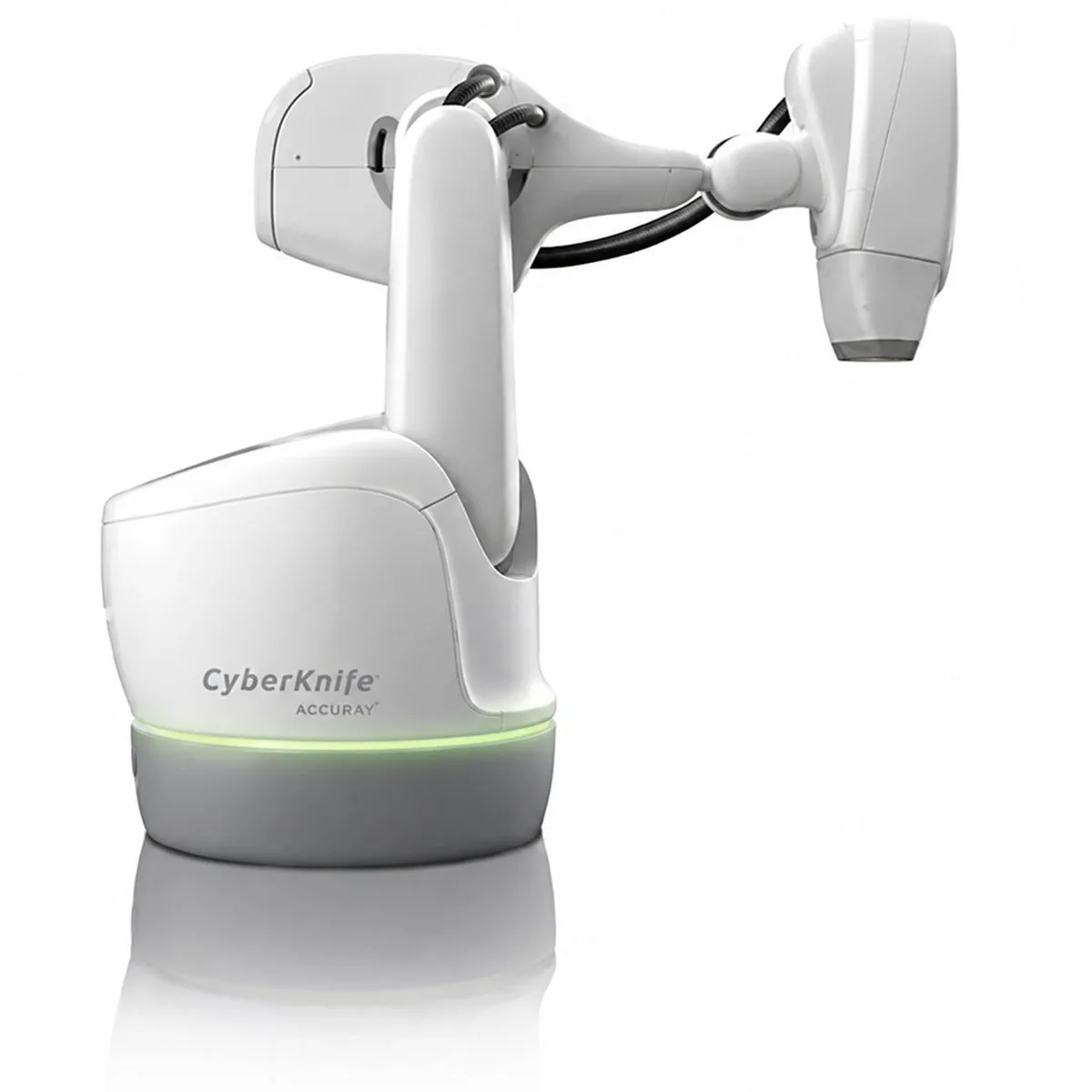
CyberKnife for cancer
Suitability depends on tumor location, tumor size, number of lesions, prior radiotherapy, and nearby critical organs.
This information is not a diagnosis or a medical recommendation. Decisions remain with your medical team.
How sources are separated
Source separation
This page separates three things that are often mixed together: provider facts, facts from guidelines or scientific publications, and TanyaKanker explanations. Every item names its class so a provider claim is not read as independent evidence.
- PROVIDER
- According to Foshan CyberKnife Center materials
- EXTERNAL
- Guideline or scientific publication
- EXPLAINER
- TanyaKanker explanation
First questions and direct answers
These are TanyaKanker explanations for the questions that usually arise first. Mentioning a tumour site is not an indication list for an individual case.
- What is CyberKnife?
- A robotic stereotactic radiotherapy platform. It directs radiation to a target with position correction during treatment. It is not a knife and not surgery.
- Is it surgery?
- No. There is no incision and no tissue removal. The effect comes from radiation, like other radiotherapy, but with a different targeting method.
- How is it different from conventional radiotherapy?
- Conventional radiotherapy usually gives smaller doses over many sessions. Stereotactic therapy gives higher dose per session in fewer sessions and requires tighter precision and position correction.
- How is it different from SBRT?
- SBRT is the technique; CyberKnife is one platform that can deliver it. They are not two mutually exclusive therapies.
- Which tumors is it usually discussed for?
- It is commonly discussed for solid tumors in the brain, lung, liver, pancreas, prostate, spine, and some other sites. This is not an indication list for an individual case.
- Is every patient suitable?
- No. Fit depends on location, size, number of lesions, prior radiotherapy, nearby organs, and the treatment goal. Record review is required.
How the workflow proceeds
One sequence runs through 7 steps, from identifying the target lesion to evaluation after treatment. This is a stereotactic-treatment workflow, not an assessment of one case.
Tumor
The lesion being discussed as a target.
Imaging
CT, MRI, or PET-CT maps target location and size.
Target localization
The team defines the target boundary and structures to protect.
Dose planning
The plan defines dose, fractions, and beam angles.
Robotic irradiation
Radiation is delivered from many angles toward the target.
Tracking and correction
Target position is checked during the session and corrected if it shifts.
Evaluation
Follow-up imaging and response assessment are handled by the team.
Radiotherapy, SBRT/SRS, and CyberKnife
These three levels explain the relationship between the treatment category, the technique, and the delivery platform. This distinction is often misunderstood.
Radiotherapy
The therapy category: using radiation to control cancer-cell growth in a targeted area.
SBRT and SRS
High-precision stereotactic radiotherapy techniques. SBRT is used for targets outside the head; SRS is used for intracranial targets. Both can be delivered by different platforms.
CyberKnife
One platform that can deliver stereotactic treatment. The platform is robotic and includes motion tracking. It is the tool used, not a separate therapy level.
When it may not be suitable
This section does not assess or exclude an individual case. It explains why a plan may be considered unsuitable so you can ask a more focused question.
- Disease has spread widely so local therapy is no longer the main focus.
- Tumor size or location means focused dose cannot be delivered safely.
- Prior radiotherapy to the same area means cumulative dose limits must be calculated.
- The treatment goal is better answered by another approach, including systemic therapy or surgery.
- The patient's overall clinical condition makes focused therapy a lower priority.
Provider review is required. There is no automatic answer, and no decision can be made from the diagnosis name alone.
CyberKnife cost
TanyaKanker does not show fixed prices. An estimate can only be built after the team reviews target location, imaging, radiotherapy history, and fractionation plan, then receives a written provider quote.
CyberKnife cost: what drives it and why there is no fixed priceView sourced facts
Publishable facts
These identity, facility, and equipment facts can be stated with their sources. The list contains no treatment-outcome claim.
Installed technology
According to Foshan CyberKnife Center materialsCyberKnife M6 (Accuray platform)
Source: Foshan CyberKnife Center materials; consistent with the hospital's official website.
Provider
According to Foshan CyberKnife Center materialsFoshan Fosun Chancheng Hospital, Foshan, Guangdong, China
Source: Official hospital website (www.fsccyy.com).
Facility status
According to Foshan CyberKnife Center materialsPublic JCI-accredited national Grade III-A hospital, operating for almost 60 years
Source: Foshan CyberKnife Center materials.
Technical leadership
According to Foshan CyberKnife Center materialsLed by Dr. Jun Yang, medical physicist; contributor to CyberKnife quality-control standards TG-135 and TG-277
Source: Foshan CyberKnife Center materials.
Contact
According to Foshan CyberKnife Center materialsTel. +86 757 8216 2888 - Address: No.3 Sanyou South Road, Shiwanzhen, Chancheng, Foshan
Source: Foshan CyberKnife Center materials.
Technology origin
Guideline or scientific publicationCyberKnife was developed by Dr. John Adler, professor of neurosurgery at Stanford University; FDA cleared it for tumors in multiple body sites in 2001
Source: Public documentation and regulatory history.
Explore related pages
Read next
Six other pages in this cluster, followed by pages explaining the parent category and technique.
- CyberKnife vs SBRT: technique, platform, and a common misunderstanding
- CyberKnife for lung cancer: targets that move during breathing
- CyberKnife for brain tumors and brain metastases
- CyberKnife cost: what drives it and why there is no fixed price
- CyberKnife in Foshan: what is verified and what is not
- Is CyberKnife relevant for your case? Request a review
- SBRT (radioterapi stereotaktik): how it works, who it is for, what to prepareSBRT (radioterapi stereotaktik): how the treatment works, who is usually considered for it, what to prepare, and the biomarkers and clinical trials linked to it.
- Radioterapi: how it works, who it is for, what to prepareRadioterapi: how the treatment works, who is usually considered for it, what to prepare, and the biomarkers and clinical trials linked to it.
- Lung Cancer: subtypes, biomarkers and treatment optionsLung Cancer: subtypes, biomarkers, diagnostics, treatment categories and related clinical trials. Review status and sources are shown on the page.
- Guides for patients and familiesStep-by-step guides on understanding trials, preparing medical reports, second opinions, biomarker results and cost preparation.
- Clinical trials: search by cancer, biomarker and countrySearch recruiting studies from the public ClinicalTrials.gov registry by cancer type, biomarker, treatment category, country and phase. Recruiting status is not a guarantee of eligibility.
Open frequently asked questions
Frequently asked questions
Short answers to common questions. The sections above provide the fuller explanation.
Does CyberKnife actually use a knife?
No. The name does not mean a cutting tool. CyberKnife is a robotic radiotherapy platform that directs radiation to a target.
Can CyberKnife be used for every cancer?
No. Stereotactic therapy is discussed only in selected situations, especially solid tumors with a definable target. Many cancers are discussed through other approaches.
Can it be considered after previous radiotherapy?
Sometimes, but it depends on cumulative dose and involved organs. Prior radiotherapy history must be included for assessment.
Is it available in Indonesia?
TanyaKanker does not state availability or unavailability in Indonesia without recent verified evidence. Confirm directly with the facility being considered.
How much does it cost?
There is no fixed tariff to display. Cost depends on number of targets, fractions, planning complexity, imaging, and provider policy.
Next step
Build a case summary from your reports so the target location, imaging, and previous treatment history can be reviewed before you decide on the next care step.
This information is not a diagnosis or a medical recommendation. Decisions remain with your medical team.